The client: a $12M D2C specialty food brand. 28 employees, Shopify, an outsourced 3PL, a small customer-service team. The founder and the Head of Operations came in asking for automation. The audit found something else first.
The full sentence was: "We probably need automation or AI because the team is spending too much time chasing status." Reasonable request. The team was drowning in status questions. But before recommending any tool, the audit traced one order through the workflow to see where the time actually went.
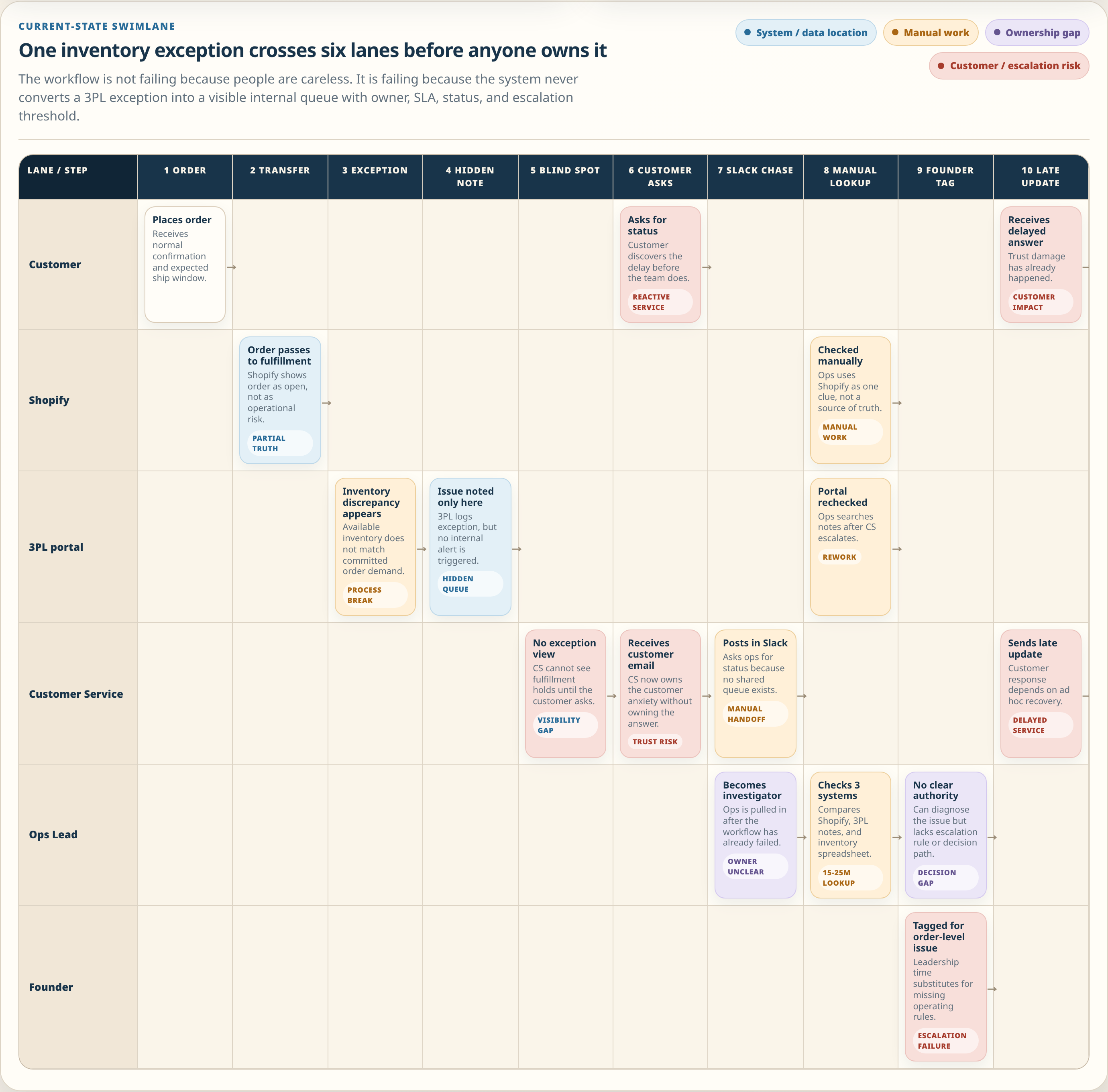
EXHIBIT 01 · CURRENT-STATE WORKFLOW
One inventory exception crosses six lanes before anyone owns it. The full document adds the evidence reviewed, the ranked risk table, and the stabilization logic.
No unified exception list. The issue lived in one portal, invisible to everyone who needed it.
Every status check meant a cross-system lookup: Shopify, the 3PL portal, a spreadsheet, Slack.
No named owner. The question bounced between CS and Ops until it found the founder.
The customer found the issue before the team did. Every update was an apology.
The founder was pulled into an order-level decision. That is not an escalation rule. That is the absence of one.
WHAT THAT COSTS, MEASURED
Illustrative figures from the audit's evidence review: 42 delayed-order samples traced from order creation to customer response.
The client did not need to eliminate every exception. It needed to control exceptions before customers discovered them.
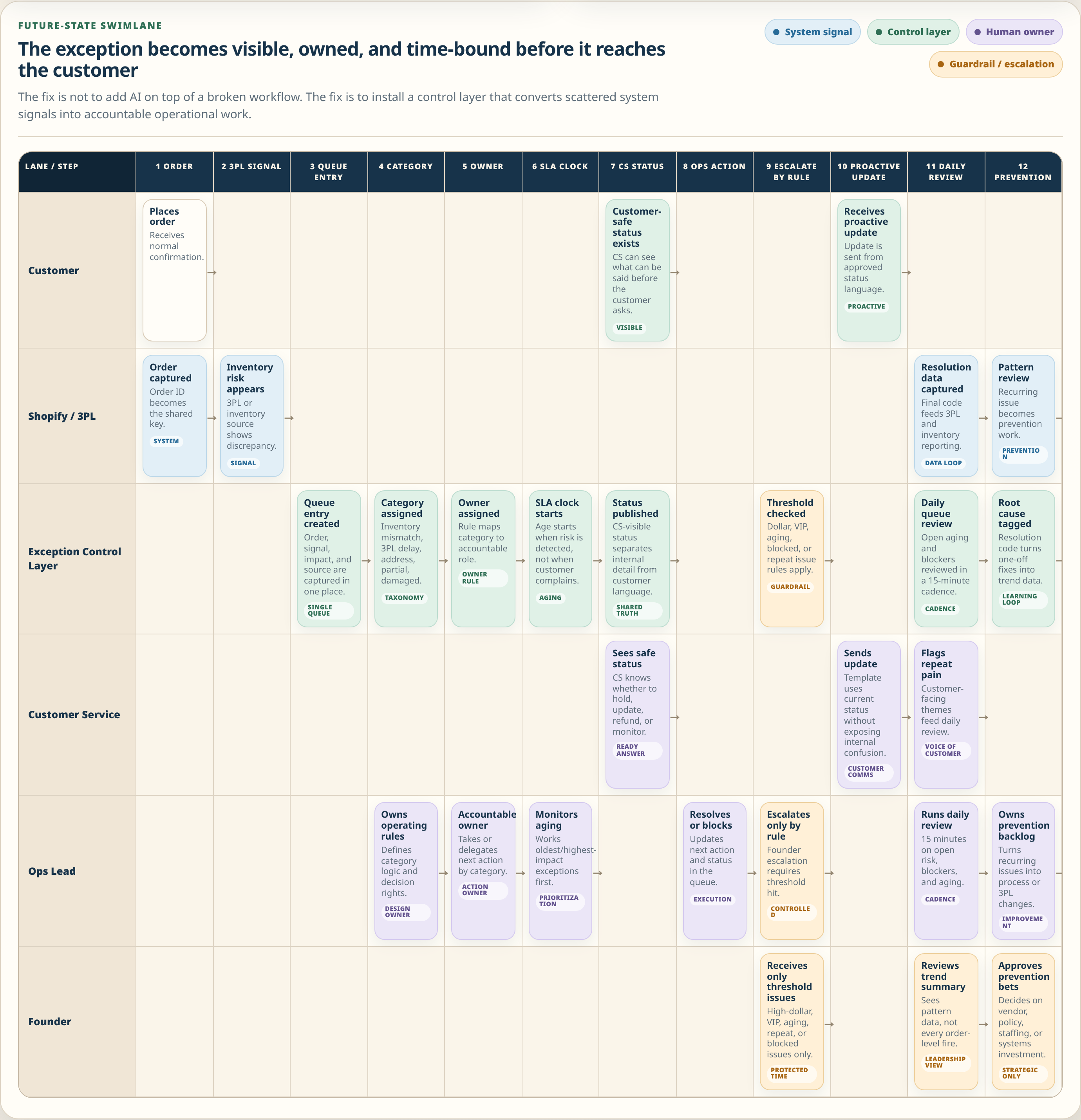
The first fix was not AI. It was an exception-control layer: one queue, one owner, one customer-safe status, one SLA clock, one escalation rule, one daily operating cadence.
Automation came after the workflow was stable, and only the safe pieces: owner routing, SLA aging alerts, a daily digest, customer-update prompts with human approval. Not AI-generated customer replies.
The scale of the leak, from the audit's evidence review: 80 to 120 exceptions a month, at 15 to 25 minutes of cross-system lookup each. That is 20+ hours of ops time every month spent finding out what is happening before anyone fixes anything. A full work week every two months, producing nothing.
EXHIBIT 02 · FUTURE-STATE WORKFLOW
The same exception, redesigned: visible, owned, and time-bound before it reaches the customer. The full document adds the owner rules, escalation thresholds, and automation readiness table.
The impact table from the audit report. Current state measured, future state targeted.
| Metric | Now | Target | How |
|---|---|---|---|
| Monthly exceptions needing manual review | 80-120 | 80-120, controlled | The goal is not zero exceptions. It is visible, owned, time-bound exceptions. |
| Lookup time per exception | 15-25 min | 3-5 min | One shared queue with standard fields replaces the cross-system hunt. |
| Monthly labor lost to status chasing | 20+ hours | 5-8 hours | Same exception volume, far fewer cross-system investigations. |
| Founder involvement in routine issues | Frequent, ad hoc | Down 60-80% | Founder sees threshold hits and trend summaries, not queue noise. |
| Customer update timing | Reactive, after the customer asks | Same-day visibility | CS sees a customer-safe status before the customer follows up. |
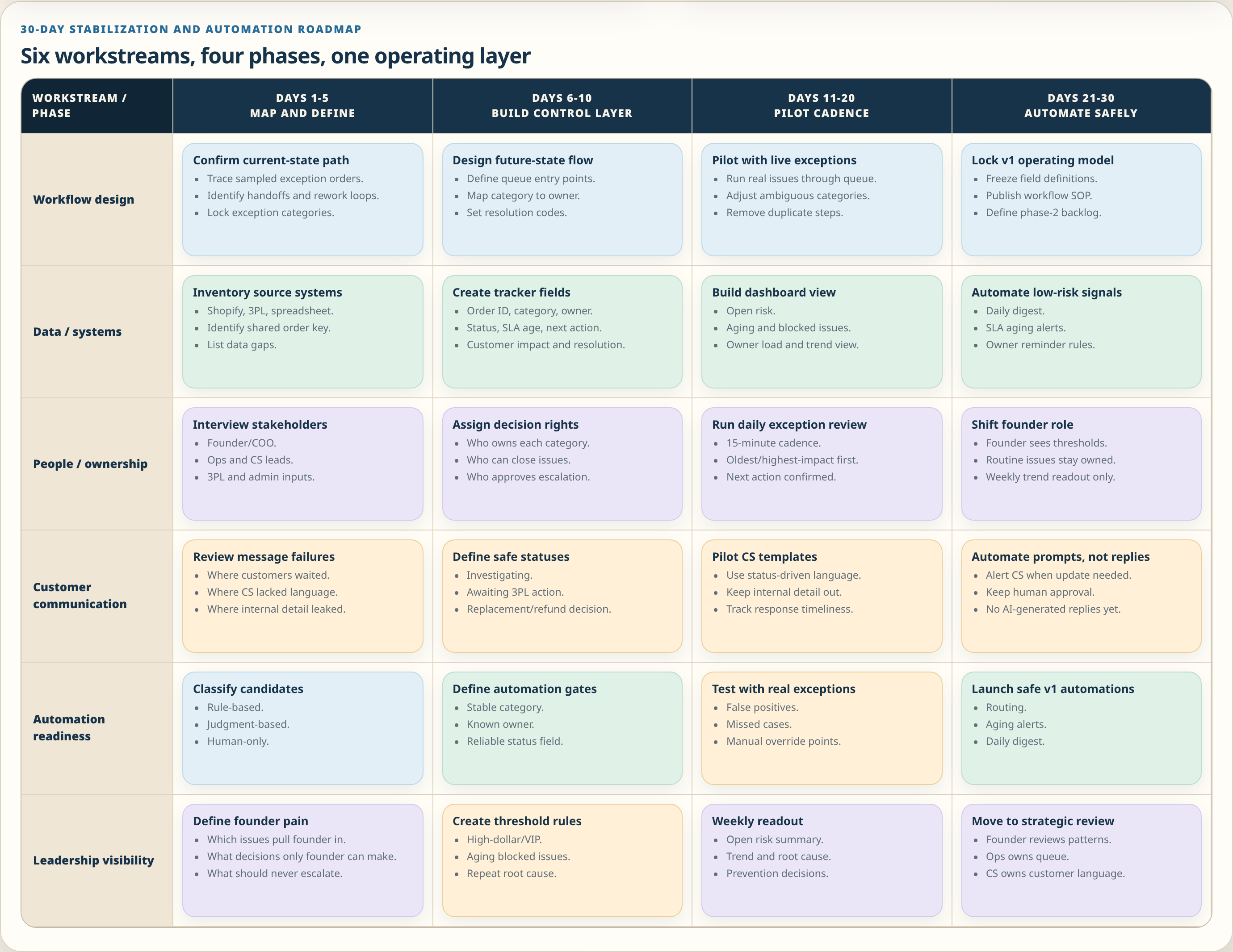
EXHIBIT 03 · THE 30-DAY ROADMAP
Four weeks from hidden exceptions to a running cadence, with automation gated to the final week. The full document adds the phase plan by workstream, the automation gates, and the handoff.
The roadmap's implementation options are five packages. Not five brochures: here is each one doing its job, in order. All of it is priced in the audit's implementation quote.
PACKAGE 01 · EXCEPTION TRACKER
Full spec →Eight fields, owner rules, statuses, and resolution codes, installed in the tools the team already uses. Illustrative rows:
| ID | Category | Owner | SLA age | Customer-safe status | Next action |
|---|---|---|---|---|---|
| EX-0141 | Inventory mismatch | Ops Lead | 3h On track | "Order confirmed, ship date unchanged." | Confirm live count with 3PL |
| EX-0142 | Address | CS Lead | 2h On track | "Awaiting your address confirmation." | Email customer to confirm unit number |
| EX-0143 | Damage | CS Lead | 1h On track | "Replacement on the way." | Send replacement, open 3PL claim |
| EX-0144 | 3PL delay | Ops Lead | 6h On track | "Slight delay, new ship date shared." | Get committed ship date from 3PL |
| EX-0138 | Partial shipment | Ops Lead | 28h Aging | "Remainder ships separately at no cost." | Book remainder; first item in today's review |
| EX-0136 | 3PL delay | Ops Lead | Blocked 5 bus. hrs VIP threshold | "Your order has our full attention. Update by end of day." | Escalated to founder per VIP rule; 3PL call booked |
Four on track. One aging, worked first in the daily review. One VIP row, the only thing the founder sees today. The queue absorbs the volume so people work the exceptions that matter.
PACKAGE 02 · DASHBOARD AND CADENCE
Full spec →The dashboard reads from the queue. The cadence guarantees someone acts on it every business day. Illustrative snapshot, then the actual daily agenda:
PACKAGE 03 · SOP AND COMMUNICATION KIT
Full spec →Internal truth translates to customer-safe language. Both versions are true; the customer-safe one removes the noise the customer cannot act on.
TEMPLATE · SHIPPING DELAY
Subject: Update on order [order number]: new ship date
Hi [first name],
Your order [order number] is taking longer to leave our warehouse than planned. We caught it on our side and have already rebooked it.
New ship date: [new ship date]. You will get tracking the moment it leaves.
No action needed from you. If that date creates a problem, reply here and we will look at options.
[CS rep name], [company name]
PACKAGE 04 · SAFE AUTOMATION SPRINT
Full spec →Starts only after the queue and cadence run stable for two consecutive weeks. Four automations ship; here is the one closest to the customer, spec'd the way all four are:
Customer-update prompts, human approval
What stays human: AI-written customer replies (not first), predictive inventory (later, when the data has history), and every judgment call on refunds and exceptions (always).
PACKAGE 05 · FRACTIONAL OPS SUPPORT
Full spec →Systems decay without an owner of the system itself. A weekly readout keeps adoption honest and turns resolution data into prevention. An illustrative healthy week:
Support ends when the team runs two stable months on its own. Graduation, not dependency.
Complete documents, for the deep read: Current-state workflow · Future-state workflow · 30-day roadmap · Tracker · Dashboard · Comms kit · Automation sprint · Fractional ops
Send 3 to 5 recent examples where work got stuck, escalated, or required manual status chasing to dan@diazovate.com. I'll tell you whether the audit is the right fit.